Skip to content

Planning

How Early Should You Arrive for a Ferry?

Check-in cut-off times for foot passengers and vehicles, and how early to get to the port so you don't miss your sailing.

Planning2 min read

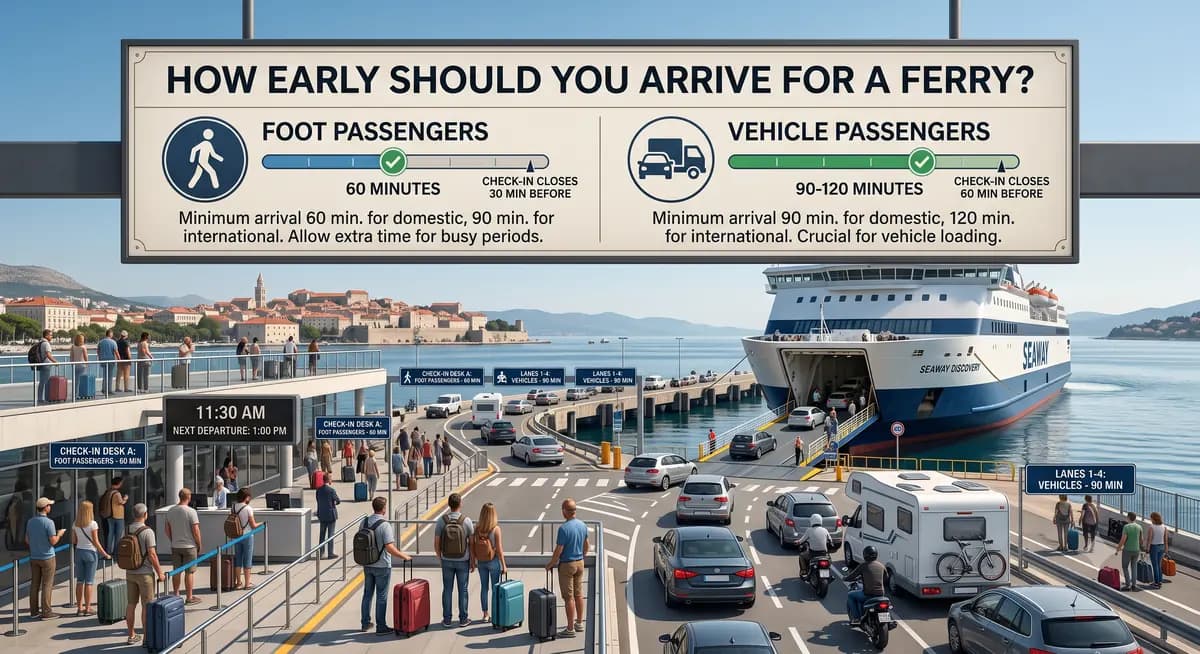
As a rule of thumb, arrive 30–60 minutes before departure as a foot passenger, and 45–90 minutes before if you're taking a vehicle. Larger international crossings ask you to arrive earlier than short domestic hops.

Check-in cut-off times

Most operators close vehicle check-in 30–60 minutes before departure and foot-passenger check-in slightly later. Miss the cut-off and you may be refused boarding even if the ferry hasn't left — the deck is loaded in sequence and can't wait for latecomers.

When to allow extra time

  • Peak season and weekends — queues at check-in and security are longer.
  • International routes — passport and, where relevant, customs checks add time.
  • Taking a vehicle — you'll be assigned a lane and loaded in order, so earlier is better.

The bottom line

Check your operator's stated check-in window for the specific route and treat it as the latest acceptable arrival, not the target. Getting there a little early costs you nothing; arriving late can cost you the crossing.

The deadline usually differs for vehicles and foot passengers

Most operators publish two separate cut-offs, and the gap between them is often half an hour or more. Black Ball prints them as two columns in the timetable itself:

Operator / routeWith a vehicleOn foot
Black Ball, Port Angeles–Victoria60 min30 min
Moby, Italy (summer)90 min60 min
Moby, Italy (1 Oct–31 May)90 min30 min
OceanJet, Philippines30 min

⚠ Season changes the answer

Moby's foot-passenger deadline is one hour from 1 June to 30 September but only 30 minutes from 1 October to 31 May. The same ship, the same port, twice the requirement depending on the month. There is no single "ferry check-in time".

What happens if you miss it

This is where operators stop being vague. OceanJet's ticket conditions state that failing to check in at least 30 minutes ahead "may mean forfeiture of confirmed seat reservation" — and that there is no refund and no revalidation for a passenger who checks in but does not board. A missed deadline is not a delay; it is a lost ticket.

Border crossings add a layer

On international sailings the deadline exists so documents can be checked, not just so the deck can be loaded. Black Ball's Port Angeles–Victoria service is a US–Canada crossing under the Western Hemisphere Travel Initiative, and the 60-minute vehicle rule is built around that inspection.

A practical rule

Take the operator's published figure, then add the walk. Large ports are not single buildings: ANEK directs Crete passengers to Gate E3 at Piraeus, which is a fair distance from where most people enter the port.


Common questions

Can I board a ferry if I arrive after check-in has closed?
Usually not. Once check-in closes the operator can refuse boarding and forfeit your ticket, even if the ship is still at the berth, because vehicles are loaded in sequence and the deck can't wait. On frequent short routes some carriers will move you to the next sailing at their discretion, often for a fee; on daily or fully booked crossings you may lose the fare entirely.
Why does vehicle check-in close before foot-passenger check-in?
Cars are loaded onto the deck in a planned order by height, weight and disembarkation point, so drivers must be in their lane well before departure. Foot passengers simply walk up a gangway, which is quicker to manage, so their cut-off is often 10–30 minutes later. Vehicle check-in typically closes 30–60 minutes before sailing.
How early should I arrive for an international ferry with a passport check?
Allow 90–120 minutes for international crossings such as Dover–Calais or Spain–Morocco. Passport control, and on some routes customs or vehicle-import paperwork, add substantial time beyond ordinary check-in. Cross-Channel foot passengers in particular are often told to arrive two hours ahead because border checks happen before you board.
Do I need to collect a paper ticket before boarding a ferry?
It depends on the operator. Many now use e-tickets or QR boarding passes you show from your phone, so you can go straight to check-in. Others, common in Greece, require you to collect paper boarding cards from a port agency 1–2 hours before departure. Check your confirmation email; if collection is required, add that time to your arrival plan.
How early should I arrive with a motorhome or when travelling with a pet?
Add roughly 30–60 minutes to the normal vehicle check-in time. Motorhomes and oversize vehicles may be measured, weighed or sent to a separate lane, and pet checks — microchip and passport — are done at check-in rather than the gate. If you need boarding assistance, most operators ask you to arrive at least 60 minutes before departure.
Is there a single answer to how early I should arrive?
No. Checking operators' own published rules gives a range from no check-in at all on city ferries (Waxholmsbolaget, ACTV, NYC Ferry) to three hours on Mediterranean international sailings (Superfast Ferries). Short island routes cluster at 20-30 minutes and pre-booked vehicles at 45-60. Use the type of crossing, not the country, to decide.
What is the earliest arrival any major operator asks for?
Of the operators checked, Superfast Ferries is the strictest: 'Passengers & Vehicles: 3 hours before departure' on its Greece-Italy services, with ticket collection from port agencies also required at least 3 hours ahead. Minoan Lines asks for vehicles to be at the port 2 hours before sailing.
Do city and commuter ferries have a check-in time at all?
Generally no. Stockholm's Waxholmsbolaget, Venice's ACTV vaporetti, NYC Ferry and similar urban networks are boarded like a bus — you tap or show a ticket and walk on. The arrival advice on this page applies to scheduled island, vehicle and international crossings.